Wireless connectivity for a batteryless device running on harvested energy is assumed to require an extremely low-power technology, such as Bluetooth Low Energy or LoRa. While both are well-suited for batteryless applications, the radio itself doesn’t have to be the limiting factor when choosing a wireless technology.
Because many IoT sensors only report measurement data periodically, wireless communication represents a relatively small percentage of the device’s overall energy consumption. That opens the door to considering other factors alongside power consumption when selecting the right technology.
In the final part of our three-part series on batteryless devices, we’ll explore best practices and common tradeoffs for designing low-power wireless connectivity, including sleep current, network topology, payload design, transmission frequency, and other decisions that have a meaningful impact on the overall energy budget.
Best practices:
- Leverage low current sleep modes. Radios and MCUs are commonly combined in a single package, which enables even lower sleep modes between communication periods. But even with this approach, these sleep modes are highly implementation dependent and require specific firmware configurations to be tightly managed. In addition, low sleep and quiescent current should be a design constraint for every component in the device. Memory, switching power supplies, sensing circuits, and even pull-up resistors all play a critical role in establishing low current sleep modes, which, at long reporting intervals, consume more energy than the wireless communication itself.

- Don’t require routing. If a mesh network topology is being used, don’t put routing responsibilities on the edge sensor device. This adds significant communication and processing overhead, increasing the energy consumption and limiting the feasibility for the sensor to run from harvested energy. Configure mesh networks to allow edge devices to be non-routing, so they only wake up when needing to communicate with the network. And if you are able to choose a star network over a mesh network, this eliminates the concern altogether.
-
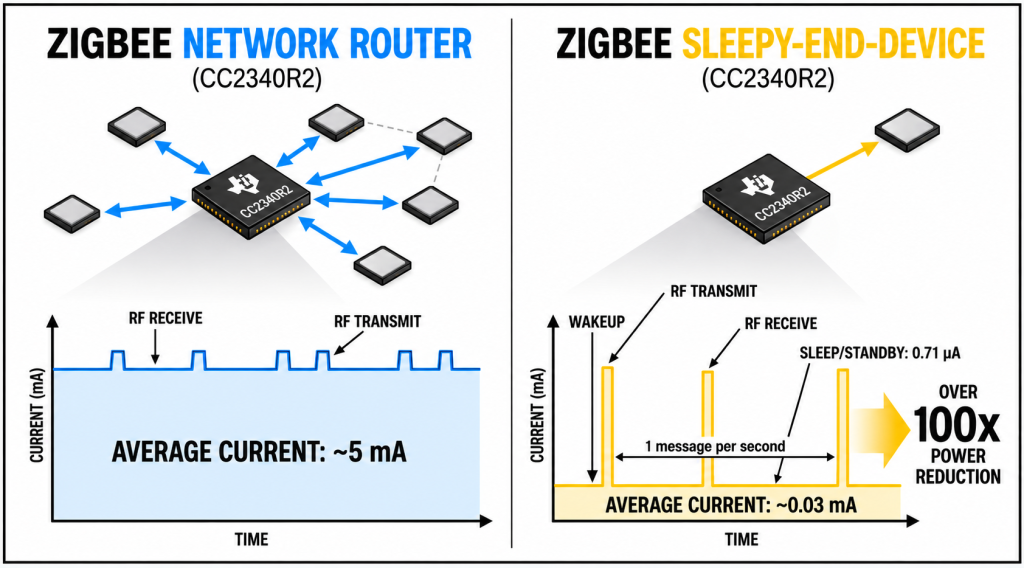
- As an example, Zigbee is a mesh network that can have devices configured as a network router or as a sleepy-end-device. A device configured as a network router must remain in receive mode continuously. Conversely, a sleepy-end-device can remain in sleep mode most of the time and only periodically wake up to communicate. Using TI’s CC2340R2 as a representative Zigbee device, and assuming light network traffic, the average current draw when configured as a router would be about 5 mA. This same device configured as a sleepy-end-device sending one message per second would have an average current draw of about 0.03 mA. This is over a 100x reduction in power consumption.
-

- Design your payloads. Not all protocols work well with low power wireless. JSON, for example, has great benefits for software developers, but adds energy-intensive overhead for wireless communication. Choose a protocol that allows efficient payloads, such as ones that support binary data and are dynamic in their length based on the message being sent. To take this one step further, consider if the data being sent can be compressed without losing application-level data. This extra processing for compression is worthwhile when it takes less energy than sending a longer wireless transmission.
Common tradeoffs:
- Bitrate vs. transmit duration. Modern radios are optimized for their highest bitrate. Operating them in this mode results in lower overall energy use since the increase in power for the higher bitrate is outweighed by the savings on a shorter transmit duration. However, receiver sensitivity, link margin, and packet reliability are all tradeoffs that drive a design towards a lower bitrate.
- Check-in interval vs. data freshness. Checking in every 10 minutes vs. every hour is a significant difference in daily transmission energy. Depending on the application, an hourly report is equally sufficient, such as temperature monitoring in a stable environment. This tradeoff can provide the design margin needed to support worst-case harvesting scenarios.
- Output power vs. range. Dropping transmit power reduces current draw with minimal range impact in most indoor deployments. Unless the application is pushing the physical range limits of a wireless technology, default to a transmit power that is lower than the radio’s maximum.
- Confirmed vs. unconfirmed uplinks. Confirmed uplinks require the radio to listen for an acknowledgment. For a batteryless sensor, unconfirmed uplinks avoid the energy cost of retransmits and receive windows, which adds up quickly. If higher success rates are needed, repeating data several times achieves this and is likely lower in energy than the handshake process for confirmed uplinks. However, if an application is not tolerant of gaps in the uplink data, such as that of an access log, then confirmed uplinks are needed and this additional energy use should be included in the power modeling.
Designing low-power wireless for a batteryless sensor isn’t simply about choosing the radio with the lowest current draw. Sleep current, network topology, payload size, bitrate, reporting frequency, transmit power, and reliability requirements all influence how much energy communication it ultimately consumes.
Across this series, we’ve explored energy harvesting, energy storage, and wireless communication as three parts of the same system. The key is balancing all three around the application’s real-world requirements and worst-case conditions. Done well, batteryless sensing reduces maintenance requirements and makes it practical to collect data from assets that previously weren’t economical or convenient to monitor.
Explore how Twisthink approaches the challenge of using batteryless sensing to monitor more assets with less maintenance.
Monitor More Assets with Less Maintenance
Twisthink helps companies rethink how connected sensing systems are powered. Rather than accepting battery replacement as an unavoidable cost, we evaluate the application, operating environment, and available energy sources to determine the best long-term solution. Whether that’s ultra-low-power electronics, energy harvesting, or a combination of both, we design systems that collect more data while requiring less maintenance.
Learn more

As the Director of Technology, Matt spearheads the development of excellent solutions tailored to meet the distinct needs of each client. Matt's expertise spans a multitude of domains, including system architecture, wireless protocol design, embedded circuit design, and firmware development, among others, all of which have played pivotal roles in his success.

